


The Story You've Never Told

Most people have a moment when God felt close — and most have never said it out loud. On August 26, three storytellers join us to talk about how congregations can change that.

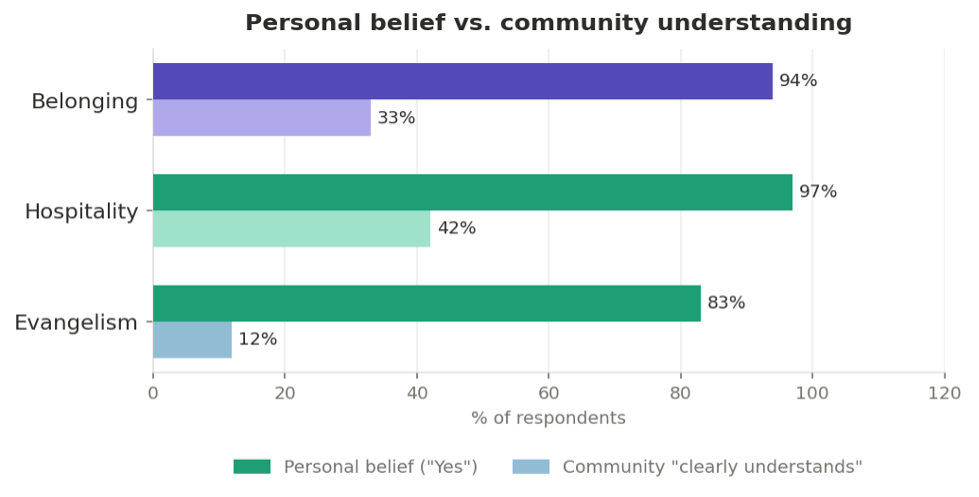
Ask a room full of faithful Episcopalians whether they've ever experienced the presence of God, and most hands will eventually go up. Ask how many have told someone about it, and the hands come down.
This is not a failure of faith. It's a failure of practice. We are a tradition that has taught its people to pray beautifully in unison and to fall silent about the particular. We know the words of the Nicene Creed by heart. We're less sure what to say when a neighbor asks, gently and sincerely, why we bother going.
That gap is where evangelism gets stuck. Not because people don't believe, but because they don't have the words—and, more to the point, because no one has ever asked them for the words in a setting where it felt safe to try.
Story is the form faith already takes
Here's what's easy to miss: your faith is already stored as a story. Not as doctrine, not as argument. As a set of moments. The funeral where the hymn undid you. The stretch of months when prayer felt like talking to a wall, and the morning it didn't. The person who sat with you. The decision you can't fully explain.
Scripture works this way too. The Bible makes its case overwhelmingly through narrative—people, places, particular Tuesdays—rather than through propositions. When Jesus is asked a direct theological question, he tends to answer with a story about a farmer or a traveler or a man with two sons.
So when we ask people to "share their faith," we're not asking them to acquire a new skill. We're asking them to say out loud a thing they already carry. The work isn't teaching content. It's building the room where it can be said.
Why this matters for welcome
Invite Welcome Connect exists on the conviction that inviting, welcoming, and connecting are practices—things a congregation gets better at by doing them, not by agreeing they're important.
Storytelling sits underneath all three.
Invite stops being frightening when it stops being a sales pitch. "Come to my church" is a hard sentence to say. "Something happened to me there, and I'd like to tell you about it" is a much easier one, and a far more honest one.
Welcome deepens past the coffee hour handshake the first time a newcomer hears a real person say something true about their own life. That's the moment a visitor learns what kind of place they've walked into.
Connect is what happens when people know each other's stories. A congregation where forty people have heard each other's hardest and holiest moments is not the same congregation it was before. It's harder to remain a stranger to someone whose story you know.
Three people who have built the room
On Wednesday, August 26, Invite Welcome Connect is hosting an online round table with three people who have each found a practical way to help others tell their stories.
The Rev. Jonathan French founded GodCorps, a simple and replicable ministry designed to help parishioners share and preserve the moments when they experienced God's presence in their lives. The emphasis on preserve is worth noticing—these stories are a congregation's inheritance, and most of them are currently being lost.
Mary MacGregor, retired Canon for Congregational Vitality and Mission Amplification in the Episcopal Diocese of Texas, will talk about Sharing Faith Dinners, where a small group gathers around a meal and tells their faith stories to one another. The table does a lot of the work. It always has.
The Rev. Dr. Caroline Carson—"The Parson Carson"—tells faith stories through poetry, photography, music, and the written word. She has shared them in 45 countries and serves on the Standing Commission on World Mission. Her presence is a useful reminder that the sermon and the testimony are not the only available forms.
A conversation, not a lecture
We're keeping this round table small on purpose. The point isn't to hear three presentations and log off; it's to talk with one another about what has actually worked, what has fallen flat, and what you might try in your own context this fall.
Bring your curiosity. Bring your questions. Bring a story if one comes to mind—you may find you've been carrying it around for years, waiting for someone to ask.
Storytelling Round Table Part of the I Wonder Series from Invite Welcome Connect Wednesday, August 26 | 2:00 pm EDT · 1:00 pm CDT · 11:00 am PDT | Online Free admission; freewill donation welcome
You'll receive the meeting link upon registration, along with reminders leading up to the event.

Comments