


Fearless Faith: A Sermon on Living Out Loud

This past weekend, Invite Welcome Connect Executive Director Steve Welch stepped into the pulpit at St. Andrew's Episcopal Church in Mount Holly, NJ, preaching for the 14th Sunday after Pentecost (Proper 14, Year A). His message speaks directly to the heart of what we do at Invite Welcome Connect.
Drawing on the story of Peter stepping out of the boat and onto the storm-tossed water, Steve names the thing that so often keeps Christians from sharing their faith: fear. Fear of seeming pushy. Fear of offending someone. Fear of being lumped in with "those" kinds of Christians. But as Jesus tells the disciples in the storm, "Take heart, it is I; do not be afraid"—and that same reassurance, Steve argues, is an invitation for all of us to live our faith out loud, gently and without apology.
That's the work of evangelism, hospitality, and belonging that lies at the center of Invite Welcome Connect's ministry: not argument or coercion, but a willingness to be present, to listen, and to let our lives point toward Christ's love. Steve shares two personal encounters—one at a hotel bar in Kalamazoo, Michigan—that show what it looks like to share Good News without ever needing to "sell" it.
Watch the video and read the full transcript of Steve's sermon below.
This Week's Readings
The readings for Proper 14, Year A, as posted on The Lectionary Page:
I will listen to what the Lord God is saying, for he is speaking peace to his faithful people
Psalm 85 is kind of the spoiler alert to this sermon, to the conclusion that I hope you’re going to draw as we talk about today’s lessons.
In all of today’s lessons, from First Kings, to Paul’s letter to the Romans, to the Gospel according to Matthew, the message is clear:
Stop being so darned scared of people finding out that you worship God.
It seems anymore that there are only two kinds of Christians in this country: the ones who keep their faith entirely to themselves to avoid offending anyone, and the ones who rub their faith in everyone’s face as though they want to offend people.
Our call is to something different.
“How are they to believe in one of whom they have never heard?” St. Paul writes. “And how are they to hear without someone to proclaim him?”
We use that verse in my ministry working for Invite Welcome Connect, an organization that helps congregations embrace the work of evangelism, hospitality, and belonging.
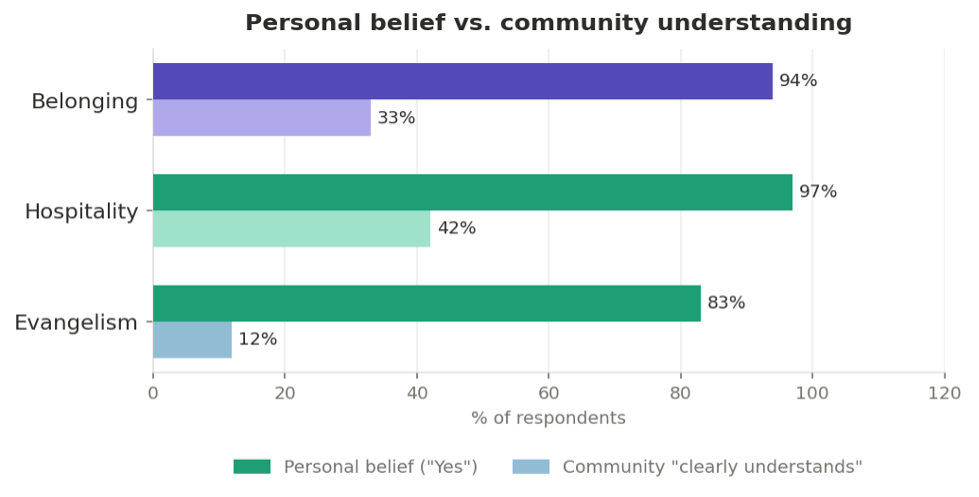
We’re not very comfortable with that word—evangelism—in The Episcopal Church. In a study my ministry did earlier this year, we found that even the most fervent evangelists in our church, sharers of the Good News of Jesus Christ, nonetheless reject that term.
It’s understandable. The image of evangelism today is not what evangelism is actually about. Evangelism is supposed to be a gentle sharing of faith. Not an argument, not coercion, certainly not a political movement. It’s a sharing of part of ourselves, the stories of our lives, what moves us and what motivates us about our faith in Christ. It’s not a simple spouting of Bible verses.
For those who are ready to hear it, it is life-giving. For those who aren’t, it does no harm.
I was in Kalamazoo Michigan last week on business. When I’m out in public, I often wear several bracelets. On each wrist, I wear a Pride bracelet and a set of beads with a cross.
The combination is very intentional. It tells LGBTQ+ people that they are safe with me, and that I believe they are beloved of God.
It tells Christians the same thing.
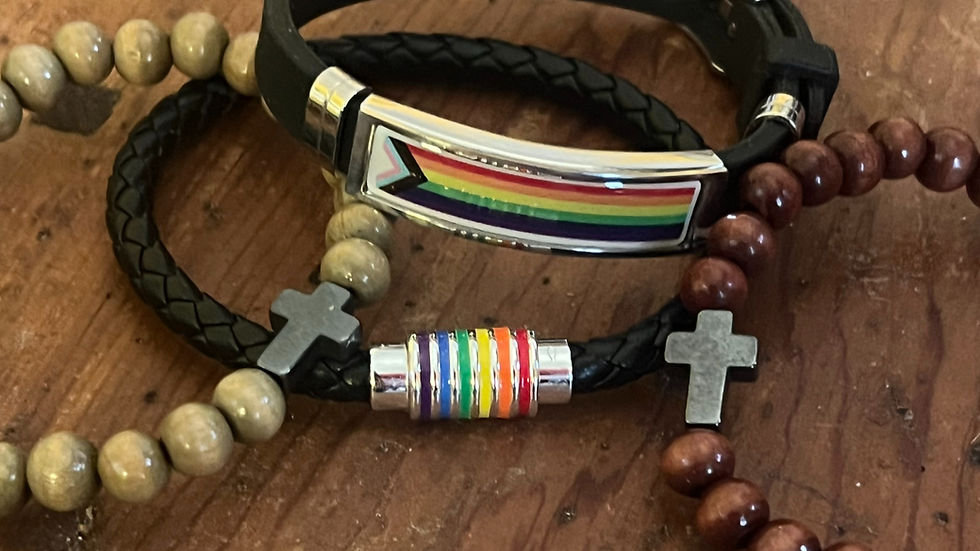
One night at the hotel bar, the man sitting next to me saw those bracelets and started talking to me about his trans child. He struggles with how to love that child, because he doesn’t understand what it means to be trans. We spoke for a long time about God’s love. We talked about how when the bible speaks out against same-sex relations, it’s almost always in the context of abusive same-sex relations, not the same-sex part. Eventually, other people joined the conversation. I shared my faith and my perspective without proselytizing, without trying to convince anyone of anything.
The next night, in the same bar (I promise I don’t actually spend a lot of time in bars), a woman sat next to me and ordered a glass of wine. She seemed upset, and so I asked her if she was okay.
She was not.
She had just buried her father that day. She came into the bar because she wanted to be surrounded by people, not be alone in her grief.
I told her that I was a hospital chaplain, and that I often talked with people right after their loved ones had passed. Rather than welcoming this news with delight, she made a noise something along the lines of “Ugh!”
She’d walked away from religion a long time ago, fed up with the hypocrisy and the small-mindedness it showed her.
If I had let my fear take hold—the fear that she might think I was one of those kinds of Christians—then I would have failed in the purpose that the Holy Spirit had for me that night.
We talked. She wasn’t looking for a theological argument, or for someone to tell her that her father was in a better place, to offer platitudes she didn’t believe. She needed someone to help her hold her grief in love and companionship. The person that God put next to her for that purpose was a Christian.
“How are they to believe in one of whom they have never heard?”
I showed that woman Jesus’ love without ever once speaking his name.
We are called to be fearless in sharing the Good News. We are called to be fearless in following Jesus.
In our Gospel lesson, Peter comes close.
Set the scene. Jesus has commanded the disciples to get into the boat, and he’s gone away. A storm comes up, a HUGE storm, that drives the boat away from shore.
The original Greek says the boat was tortured by the waves—tortured!
We’re told the disciples are terrified, and that’s understandable. The boat they are in is being tortured. It’s understandable, but it’s also a failure to fully trust in Jesus. Jesus ordered them into that boat, and they should know by now that Jesus doesn’t do anything by accident.
Jesus comes walking out on the sea, and this terrifies the disciples too.
“Take heart,” Jesus tells them. “It is I; do not be afraid.”
Dudes, I’m the one who put you in this boat. Do you think I’d let something bad happen to you?
Peter sees this, a little bit. He knows that if Jesus commands it, he can walk on the water too, on the water that is torturing the boat.
And so he does, for a little while. But what stops him? What causes him to start to sink? Fear again. Fear.
But when Peter’s fear overwhelms him, he does the right thing. He cries out to Jesus, “Lord, save me,” and Jesus does. As he always does.
“You of little faith, why did you doubt?” Jesus asks.
And so I ask you the same thing. Why do you doubt? What’s keeping you from living your faith out loud?
Elijah hides for fear of those who are out to get him because of his work for the Lord. God tells him to go back.
Peter walks on the water, but falters, and Jesus asks him, “Why did you doubt?”
Quoting Deuteronomy, Paul says:
“The word is near you, on your lips and in your heart.”
If you’re here, in this place, there’s a pretty good chance the word is in your heart.
But we’re not always great at having the word on our lips. We’re embarrassed. We’re shy. We’re afraid. What will people think of us? Will we make them uncomfortable? Will we seem weird?
We certainly don’t want to be seen as one of those evangelists.
A quote comes to mind from Franciscan theologian Richard Rohr:
“The best criticism of the bad is the practice of the better.”
Be an evangelist, but don’t be a bad evangelist. Listen more than you talk, and when you talk, do it with love and with concern for the other. It can be scary, I know, but Jesus tells us:
“Take heart, it is I; do not be afraid.”
With that verse, that word in your heart, you need only to allow it to rise to your lips. Not your word, but God’s word. Set yourself aside, and allow yourself to speak with and through God’s love.
“How are they to hear without someone to proclaim him?


Comments